

Battery Tender vs. Trickle Charger vs. Disconnecting the Battery
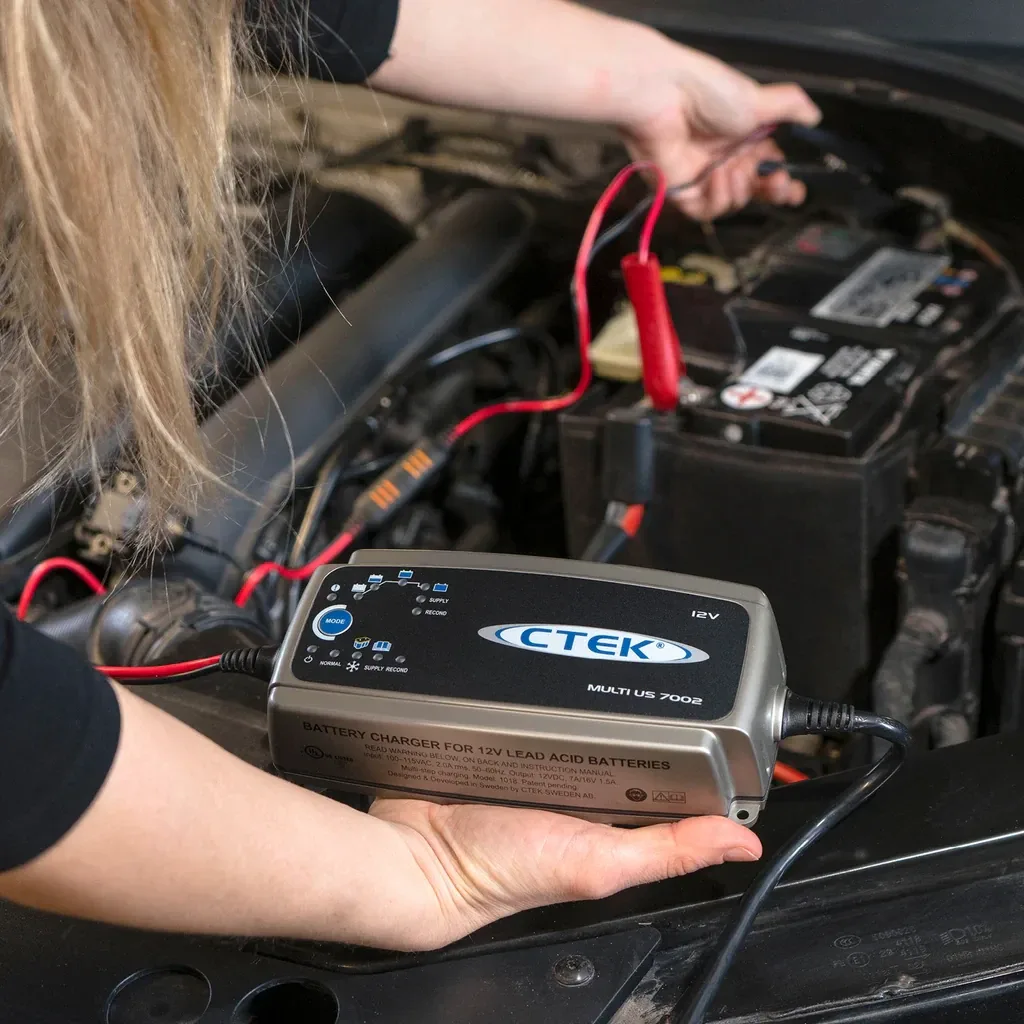
Use a modern multi-stage maintainer. It monitors the battery and only charges when the voltage drops, so it can stay connected for the whole season. An unregulated trickle charger pushes current continuously and will overcharge a full battery. Disconnecting stops the parasitic draw but does nothing about self-discharge, and it is the right answer only when no power is available.
What is the difference between a battery tender and a trickle charger?
The difference is regulation. A trickle charger delivers a small constant current, typically between 500 mA and 2 A, and keeps delivering it whether the battery needs it or not. A multi-stage maintainer measures terminal voltage and decides what the battery needs, which is why one can be left connected for months and the other cannot.
A maintainer works through defined stages. Bulk charging at constant current brings the battery up, absorption holds it at roughly 14.4 to 14.8 V for a flooded battery while the current tapers off, and float or maintenance mode then either holds around 13.2 to 13.8 V or stops charging entirely and restarts only when voltage falls below a set threshold. Better units also compensate for temperature, raising the target voltage as the battery gets colder by roughly 18 mV per °C for a 12 V battery.
An unregulated trickle charger has none of that. Once the battery reaches full charge, the current it is still receiving has nowhere useful to go, so it splits water in the electrolyte into hydrogen and oxygen. A flooded battery loses electrolyte and the plates begin to corrode. A sealed AGM battery cannot be topped up, so the same process is terminal rather than inconvenient. Five months of that will destroy a healthy battery.
A note on the name
“Battery Tender” is a brand name that has drifted into general use, the way people say Thermos or Hoover. The useful distinction is not the word on the box but whether the unit is microprocessor-controlled and multi-stage. Some products sold as trickle chargers are properly regulated, and some inexpensive units labelled as maintainers are not. Check the specification for float or maintenance mode and for a stated chemistry setting.
Why does a car battery go flat in storage anyway?
Two separate things drain it, and only one of them stops when you disconnect the terminals. Self-discharge is internal and runs at roughly 3% to 5% a month for a flooded lead-acid battery at 20 °C to 25 °C, or about 1% to 3% for AGM. Parasitic draw is the current the vehicle keeps pulling for keep-alive memory, the alarm, telematics and receiver modules.
The parasitic figure is the one that surprises people. A modern car settles to somewhere around 15 to 50 mA once its modules go to sleep, which typically takes 30 to 60 minutes after the doors are locked. Work it through at 30 mA:
- 0.03 A × 24 hours = 0.72 Ah per day
- Over 150 days, that is roughly 108 Ah
A typical passenger car battery holds 60 to 70 Ah. The parasitic draw alone therefore exceeds the battery’s entire capacity well before spring, and even a low 15 mA draw comes to about 54 Ah over the same period. This is arithmetic rather than an estimate, and it is why a car left connected and unattended from November to April is reliably flat when you come back.
What actually kills the battery is sulphation
A flat battery is not merely empty. As a lead-acid battery sits discharged, the lead sulphate on the plates coarsens into hard crystals that no longer readily convert back during charging. Capacity loss from this is progressive and largely permanent, and it starts well before the battery is fully dead.
The practical threshold is a resting voltage of about 12.4 V, which corresponds to roughly 75% state of charge. Below that, sitting for weeks does measurable harm. Useful reference points for a 12 V flooded battery measured after at least four hours with no load, since surface charge otherwise inflates the reading:
- 12.6 to 12.7 V: fully charged
- 12.4 V: about 75%
- 12.2 V: about 50%
- 12.0 V: about 25%
The relationship between state of charge, open circuit voltage and electrolyte specific gravity is well documented if you want to cross-check against a hydrometer reading on a flooded battery.
Freezing is the other risk
Electrolyte freezing point depends almost entirely on state of charge, because a discharged battery’s electrolyte is closer to water. A fully charged battery is safe to somewhere around −60 °C. At 50% charge that rises to roughly −24 °C, and a fully discharged battery can freeze near −8 °C. Frozen electrolyte expands, buckles the plates and can split the case.
An unheated GTA garage reaches −20 °C in a cold snap. A battery that has been sitting since November at 40% charge is inside the range where this becomes a real possibility rather than a theoretical one.
Should I disconnect the battery for winter storage instead?
Disconnecting stops the parasitic draw entirely, which removes the larger of the two drains. It does not stop self-discharge, so over five months you would expect to lose 15% to 25% and come back to a battery sitting somewhere around 75% to 85%. That is survivable for one season and progressively worse over multiple years.
The costs are not electrical. Depending on the vehicle, pulling the negative terminal can mean:
- Loss of radio and navigation security codes on older cars
- Reset of ECU adaptive learning, including idle and transmission shift adaptations, which the car relearns over the first several drives
- Loss of seat, mirror and climate memory positions
- Steering angle sensor or window and sunroof position relearn procedures on some models
- A battery that has to be re-registered to the vehicle’s battery management system, which is now common on European cars
- The alarm and immobiliser going dead for the entire storage period, which matters more in a driveway than in secure car storage
On an older car with no engine management and no alarm, none of that applies, and disconnecting is a reasonable low-cost approach. That is one reason it remains common practice in classic car storage while being a poor fit for a late-model car.
If you do disconnect, take the battery out and store it somewhere above freezing rather than leaving it in a cold engine bay, and put it on a charger monthly.
Which option should you choose?
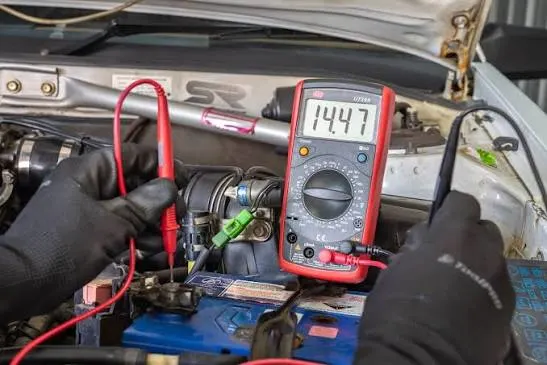
Match the method to whether you have power at the storage location and how long the car is sitting.
- Power available, car stored for a season. Multi-stage maintainer, connected for the whole period. This is the default and there is no good reason to do anything else.
- Power available, storage running past a year. Maintainer plus a physical check every month or two. Watch a flooded battery for electrolyte loss, which indicates the unit is overcharging.
- No power at the storage location. Remove the battery, store it above freezing, and charge it monthly. Disconnecting and leaving it in the car is the worse version of this.
- Older car, no power, no electronics to lose. Disconnecting is defensible. Still recharge monthly.
- Never. An unregulated trickle charger left connected for a season, or a battery left connected with neither a maintainer nor a disconnect.
Is it safe to leave a maintainer connected for five months?
Yes, if the unit is genuinely multi-stage and set for the correct chemistry. That is precisely the duty cycle these are designed for, and a quality maintainer spends most of a winter doing nothing at all, waking only when voltage drops.
Three practical points. Connect the clamps or ring terminals to the battery first and plug the unit into the mains afterwards, then reverse that order when disconnecting, so any spark happens away from a battery that may be venting hydrogen. Hydrogen is flammable in air from about 4% by volume, which is a reason to keep a flooded battery ventilated rather than sealed in a closed box. And fit a fused ring-terminal pigtail if the car goes away every year, since repeatedly clamping onto terminals is how posts get damaged.
Does the battery type change the answer?
Yes, and using the wrong mode is a common way to ruin an expensive battery. Most maintainers have a chemistry selector, and it is not decorative.
- Flooded lead-acid. The most tolerant. Electrolyte can be topped up with distilled water if a little is lost.
- AGM. A tighter voltage window and no way to replace lost electrolyte. Use the AGM setting.
- Gel. The least tolerant of overvoltage and easily damaged by a standard lead-acid profile. Uncommon in cars now, but check before assuming.
- Lithium iron phosphate. Needs a lithium-specific charger. There is no float stage, and desulphation or pulse modes intended for lead-acid can damage the pack. Charging LiFePO4 below 0 °C causes lithium plating and permanent capacity loss, which is why many packs have a battery management system that blocks charging when cold. A heated space is not optional for these.
- Hybrids and EVs. The 12 V auxiliary battery behaves like any other, but the traction battery has its own storage requirements and target state of charge. Follow the manufacturer’s guidance rather than general advice.
How MyAutoStorage handles batteries
An intelligent battery tender connection is included with every vehicle at MyAutoStorage, with no tiers and nothing to add on. The facility is climate-controlled year-round with regulated temperature and humidity, which keeps batteries out of the range where a partly discharged one is at risk of freezing and slows the chemistry that drives self-discharge. Regular visual inspections mean a connection that has come loose is found during the season rather than in April. Mike and Rob are collectors themselves, so if you are storing something with an unusual battery setup, say so when you book long-term vehicle storage in Toronto. To discuss a specific car, get in touch or call +1 (416) 571-7955.
FAQ
How often should I check a battery that is on a maintainer?
Monthly is sensible if you have access, though a good unit will run a season unattended. Look for three things: the status light showing maintenance rather than a fault, the connections still tight, and on a flooded battery the electrolyte level. Electrolyte that has dropped noticeably means the unit is overcharging and should be replaced rather than reconnected.
Will disconnecting the battery erase my radio code and settings?
On most cars, yes, to some degree. Older vehicles may need a security code to reactivate the head unit, and almost any car will lose clock, memory seat and mirror positions, and ECU adaptive learning. The car relearns most of it over the first several drives. Check whether your vehicle needs a battery registration procedure, which is common on European models.
What voltage should my battery read after winter storage?
Measure it after the car has sat at least four hours with no load, since surface charge inflates a fresh reading. Around 12.6 to 12.7 V is fully charged, 12.4 V is roughly 75%, and 12.2 V is about 50%. Anything reading below 12.4 V after storage suggests the maintenance arrangement did not work as intended.
Do I need a different charger for an AGM battery?
You need a charger with an AGM setting, which most modern maintainers have. AGM batteries have a narrower acceptable voltage range than flooded ones and cannot be topped up if they lose electrolyte to overcharging. Using a flooded profile on an AGM battery will not fail immediately, but over a five-month storage period it shortens the battery’s life.
Is it bad to store a battery on a concrete floor?
This is a genuine myth with a real origin. Very old batteries in hard rubber or wooden cases could discharge through a damp floor. Modern polypropylene cases do not. What a cold slab does do is keep the battery colder than the surrounding air, which is only a problem if the battery is already partly discharged and the space is unheated.