

How to Prevent Tire Flat-Spotting During Long-Term Storage
You prevent flat-spotting by reducing how hard the tire is pressed into its contact patch, or by removing the load entirely. In practice that means raising cold pressure to the sidewall maximum, using tire cradles, or putting the car on stands. Temperature matters as much as any of them, since cold rubber takes a set far more readily.
What causes a tire to flat-spot in storage?
A tire is a composite structure held in a circular shape by internal pressure and by its belt package, and it deforms where it meets the ground. Parked, that deformation never moves. The rubber and the textile cords in the deformed region slowly relax into the held shape, which is a viscoelastic process rather than damage in the usual sense.
The construction matters. A modern radial has body plies of polyester or rayon, steel belts, and on most speed-rated tires a nylon cap ply wrapped over the belts. Nylon is the specific troublemaker. It relaxes when hot and sets as it cools, so a tire parked hot after a spirited drive and left overnight can show a flat spot by morning that was not there the previous afternoon.
Temperature governs how readily the set forms and how hard it is to reverse. Rubber stiffens progressively as it cools, and the practical threshold for most summer and performance compounds sits around 7 °C. Below that, the compound resists returning to its original shape, so a tire stored at −5 °C in an unheated garage holds a set that the same tire at 18 °C would shrug off.
Temporary set versus permanent set
Most flat spots are temporary. The rubber has relaxed but the cords have not, and flexing plus heat returns the tire to shape, usually within the first 15 to 30 kilometres of driving.
A permanent set is different. The cords themselves have taken the deformation, or the rubber has aged and stiffened in the deformed shape and will not recover. That produces a vibration that persists no matter how long you drive, and the only fix is replacement. Older tires, bias-ply construction, and very long storage periods are what move a tire from the first category to the second.
How long does it take for a tire to flat-spot?
Anywhere from one night to several months, depending on five variables: inflation pressure, load per tire, temperature, tire construction, and tire age. There is no single threshold, which is why manufacturer guidance tends to be vague on the point.
Rough shape of it, assuming a car sitting undisturbed:
- Overnight. Detectable on speed-rated performance tires parked hot, clearing within the first few kilometres.
- Two to four weeks at 15 °C to 20 °C, properly inflated. Usually nothing lasting.
- One to two months in an unheated garage. A temporary set that typically clears in 15 to 30 kilometres of normal driving.
- Four to six months, cold and at placard pressure. A set that takes longer to work out, and on tires more than about six years old may leave a residual vibration.
- Beyond twelve months without the car being moved. The risk of a permanent set rises sharply, particularly on bias-ply and older radial construction.
Those are ranges rather than thresholds, and the same car on the same tires will behave differently at +18 °C than at −8 °C.
What is the best way to prevent tire flat spots in storage?
Taking the load off the tires prevents it completely. Everything else reduces severity rather than eliminating it. The options below run from most to least effective, and the right choice depends on how long the car is sitting and whether anyone can reach it during that time.
- Jack stands. The only method that removes the problem rather than managing it. Place the stands under the manufacturer’s designated lift points or under the lower control arms, and leave the tires inflated so the sidewalls are not sitting collapsed. Support under the control arms is generally better than under the frame, because it keeps the suspension nearer to ride height.
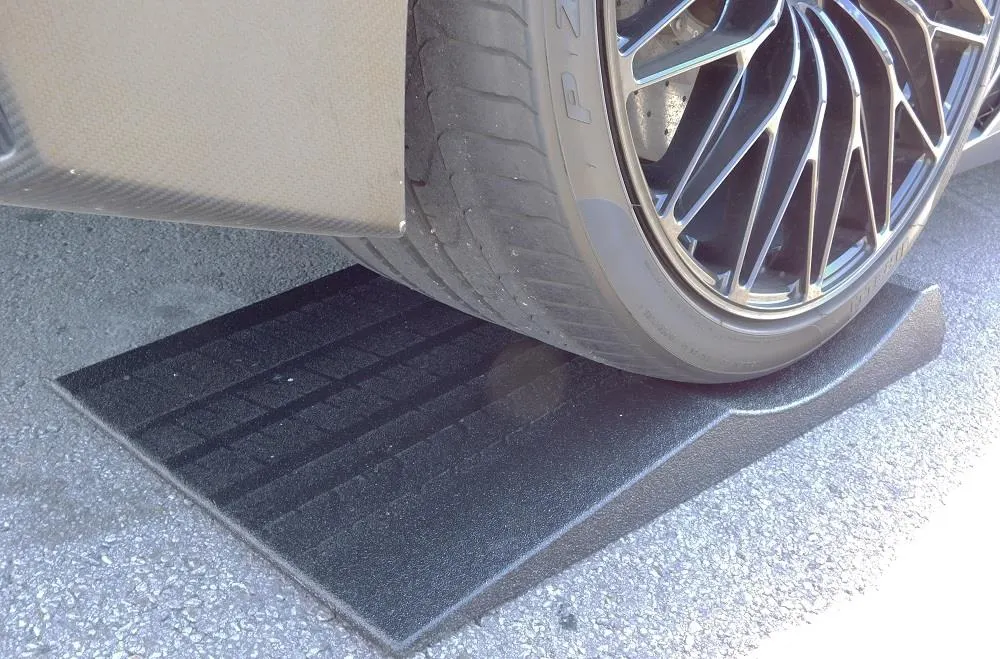
- Tire cradles. Moulded polyethylene beds with a curved surface matching the tire’s outer diameter. They spread the load across a much longer arc of tread instead of concentrating it in a flat patch. Considerably cheaper than a set of stands, with no effect on the suspension, and they have to be sized to the tire diameter to work.
- Raised cold pressure. Covered in the next section. This is the default for most seasonal storage because it costs nothing.
- Moving the car. Rolling it forward or back by half a wheel rotation every three or four weeks relocates the contact patch. It does not reverse an existing set, because rolling a car a metre does not warm the tire, but it stops any one point being loaded for the whole period. This requires aisle space and someone with access.
- Temperature. Keeping the tire above roughly 10 °C to 15 °C keeps the compound compliant. It is passive and it applies continuously, which is why it does more work over five months than its position on this list suggests.
For storage running past a year, taking the wheels off entirely is worth considering. Mounted and inflated tires should then be stored upright or hung rather than stacked flat under their own weight.
Getting the jack stand part right
Leaving a car at full suspension droop for months has its own costs. Half-shafts and CV joints sit at extreme angles, dampers stay fully extended, and on some cars a coil spring can unseat if the suspension hangs unloaded. Supporting under the control arms or the axle keeps the geometry close to normal and avoids all of it. Check the manufacturer’s lifting instructions before committing to placement, since a few cars have specific restrictions.
How much should you inflate tires for storage?
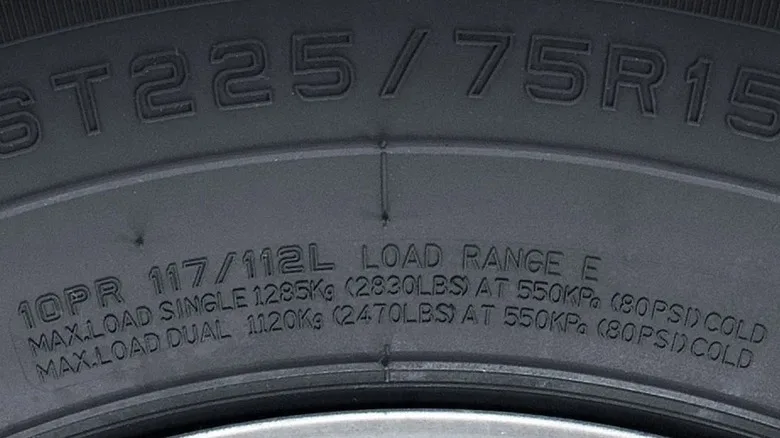
Set them to the maximum cold inflation pressure moulded on the sidewall, not the placard figure. The placard number is a driving pressure, balanced for ride quality, grip, load carrying and wear. None of that applies to a stationary car, where the only goal is minimum deflection at the contact patch.
Those are two different numbers and they are commonly confused. As Michelin Canada sets out, the MAX LOAD and MAX PRESS markings on the sidewall are limits rather than recommendations, and the vehicle placard governs normal driving. For storage you are deliberately using the sidewall limit instead.
Four practical points:
- Do not exceed the sidewall figure. It is a cold pressure limit. Pumping past it because a forum post suggested a number is how you damage a tire or a wheel.
- Account for temperature. Pressure falls roughly 1 psi for every 5.5 °C drop, so a tire set on a warm afternoon reads lower once the car has been sitting in a cooler space. Set it, then recheck a day later.
- Never store a tire under-inflated. A soft tire has a larger contact patch and more deflection, which is the opposite of what you want, and a very low tire risks unseating the bead.
- Reduce to placard pressure before driving. Leave a note on the steering wheel. An over-inflated tire on a cold road in April has a small contact patch and very little grip.
Which tires are most at risk?
The ones with stiff or unusual construction, the ones carrying the most weight, and the ones that are already old. Front-engine cars flat-spot the front tires first, since that axle carries more of the static load.
- Speed-rated performance tires. The nylon cap plies that let a tire hold together at high speed are the same plies that set overnight. V, W and Y rated tires are the usual candidates.
- Bias-ply and early radials. Crossed cords at roughly 30 to 40 degrees, thick sidewalls and no rigid steel belt to hold the casing circular. These take a set readily and are the most likely to keep it permanently, which is one reason classic car storage usually involves cradles or stands rather than just added pressure.
- Run-flats. Heavily reinforced sidewalls distribute load differently and are slower to recover. They also tend to be fitted to heavier vehicles, which compounds it, and are common enough in luxury car storage to be worth checking before a car goes away.
- Heavy vehicles. Load per tire is the variable. A 2,400 kg SUV puts substantially more into each contact patch than a 1,300 kg coupe on the same tire size.
- Older tires. Rubber that has already oxidised and stiffened has less capacity to recover. Check the date code, which is the final four digits of the DOT marking on the sidewall, giving week and year of manufacture. Guidance on age-based replacement varies between sources, and Michelin’s own position is that age alone does not determine serviceability. Treat an old tire as a reason for more careful storage, not automatically as a reason to replace.
How do you get rid of a flat spot after storage?
Drive the car gently until the tires reach operating temperature, which takes roughly 15 to 30 minutes or 20 to 30 kilometres. A temporary set fades progressively as the tread warms and flexes. If the vibration is unchanged after that, the set is likely permanent and the tires need inspecting.
Do not drive hard on a cold flat-spotted tire. The vibration is the casing trying to rotate out of round, and loading it at speed before it has warmed puts stress on wheel bearings and suspension components for no benefit.
One diagnostic point worth knowing, because it saves people replacing perfectly good tires. A flat spot produces a speed-dependent vibration felt through the whole car, usually worst somewhere between 80 and 110 km/h, and it fades as the tires warm. Surface rust on the brake rotor faces produces a pulsation felt through the brake pedal under braking, and it clears after a few firm stops. Those are different faults with different fixes, and a car coming out of long-term vehicle storage in Toronto can easily have both at once.
How MyAutoStorage handles tire flat-spotting
Tire pressure monitoring is included with every vehicle at MyAutoStorage, along with regular visual inspections, so pressures are checked through the storage period rather than set once in October and forgotten. The facility is climate-controlled year-round with regulated temperature and humidity, which keeps the compound well above the range where cold rubber holds a set. Mike and Rob are collectors themselves and will discuss cradles, stands or wheel removal for cars going into storage for longer than a single season. Capacity is deliberately limited. To talk through a specific car, get in touch or call +1 (416) 571-7955.
FAQ
Is it bad to store a car on a concrete floor?
The idea that concrete draws something out of the rubber is a myth. What concrete does do is stay cold, so a tire sitting on an unheated slab runs colder than the air around it, and cold rubber takes a set more readily. A piece of plywood or a rubber mat under each tire helps slightly. Climate control helps considerably more.
Should I put my car on jack stands for winter storage?
For a single five-month winter on modern radials, usually not. Properly inflated tires in a heated space recover within the first 20 or 30 kilometres. Stands are worth the effort for cars on bias-ply or older tires, for storage running well beyond one season, or for anything where a permanent set would mean replacing expensive period-correct rubber.
Do tire cradles actually work?
Yes, and they are the best value of the available options. By supporting a curved arc of tread rather than letting the tire deform against a flat floor, they cut peak deflection substantially without touching the suspension. They need to match the tire’s outer diameter to seat properly. A cradle sized for a different tire supports the wrong part of the tread and does very little.
Should I take the tires off if I am storing a car for a year or more?
It is worth considering past about twelve months, particularly on older or bias-ply tires. Removed tires that stay mounted and inflated should be stored upright or hung rather than stacked flat, since stacking loads the bottom tire in the pile. Storing the car on stands achieves much the same thing with less handling involved.
Do winter tires flat-spot differently from summer tires?
Winter compounds stay pliable at much lower temperatures by design, so they resist taking a set in cold storage better than summer compounds do. The trade-off is that the softer compound deforms more readily under load in the first place. In a heated facility the difference largely disappears, since both are well above the temperature where set becomes a concern.